
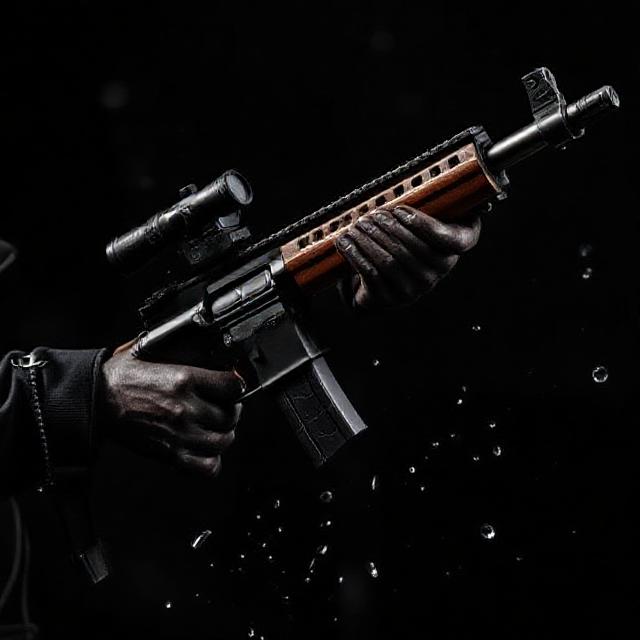
The Evolution of the Assault Rifle: A History Lesson
From the StG 44 to modern modular platforms — how one category reshaped infantry warfare.
What Makes an Assault Rifle an Assault Rifle?
The term “assault rifle” is often abused in politics and pop culture. In firearms history, it has a specific meaning: a shoulder‑fired rifle using an intermediate cartridge, fed by a detachable magazine, and capable of selective fire (semi‑automatic and fully automatic or burst). It sits between full‑power battle rifles and pistols/submachine guns.
This middle ground—controllable recoil with enough range for modern combat—created a category that would dominate wars for the last 80 years.
The Birth of the Concept (World War II)
Early 20th‑century armies believed long‑range firefights decided battles. Reality proved otherwise. Most engagements happened under 300 meters, where full‑power rifles produced too much recoil for rapid fire and wasted energy on unneeded range.
Germany responded with the StG 44 (Sturmgewehr 44). It used a shorter intermediate round and offered semi‑auto or full‑auto fire. Soldiers could carry more ammunition, fire faster, and stay accurate enough for typical battlefield distances. The StG 44 wasn’t the first automatic rifle, but it was the first to perfectly match battlefield math.
The Cold War Explosion: AK‑47 and the Soviet Model
After WWII, the Soviet Union refined the idea into the AK‑47 and later AKM. Mikhail Kalashnikov’s design emphasized reliability over elegance. The rifle was simple, rugged, and easy to produce in huge numbers. It tolerated mud, dust, and abuse—conditions common in conflict zones worldwide.
By the 1960s, the AK family had become the world’s most distributed firearm, carried by state armies and guerrilla movements alike. Its spread was both military and political: the rifle was a tool of revolution, proxy war, and ideological export.
The Western Answer: M16 and Lightweight Velocity
The United States initially resisted intermediate cartridges, but the Vietnam War forced change. Jungle fighting demanded lighter rifles and higher controllability. The M16 adopted a small calibre, high‑velocity round (5.56×45mm). The philosophy was different from the AK: precision, low recoil, and modular engineering.
Early M16 issues (especially with maintenance and ammunition) created painful lessons, but the platform evolved into one of the most adaptable rifle families ever made.
Design Philosophies Compared
- AK tradition: loose tolerances, simple controls, extreme reliability, easier manufacturing.
- AR/M16 tradition: tighter tolerances, modular parts, superior ergonomics and accuracy, more maintenance‑sensitive.
Neither is “magic.” Each reflects the battlefield and industrial assumptions of its origin.
Modern Evolution: Rails, Optics, and the “System Rifle”
By the 1990s and 2000s, assault rifles stopped being just rifles. They became platforms. Picatinny and later M‑LOK rails let soldiers attach optics, lasers, lights, grips, and grenade launchers. A rifle could be configured for urban clearing at sunrise and long‑range cover by noon.
Optics were the real revolution. A simple red‑dot sight can double an average soldier’s hit probability. Today the rifle is part of a network: linked to drones, radios, and targeting information.
Assault Rifles in Africa
Africa’s post‑colonial conflicts coincided with the global spread of the AK. That made it the continent’s dominant rifle. It was cheap, durable, and easy to train with. From liberation struggles to civil wars, the AK family became both a weapon and a symbol.
But Africa also saw diversification: South Africa developed and used platforms like the R4/R5 series, influenced by Israeli Galil designs. Many states now blend AK variants with AR‑style rifles depending on suppliers and doctrine.
The Ethical Shadow
Assault rifles lowered the barrier to sustained firepower. That made them militarily efficient—but also attractive to militias and criminal networks. When a tool is easy to use, it spreads fast. The rifle’s moral weight therefore depends on who wields it and for what purpose.
Traditional conservative ethics holds that power must be disciplined. A rifle in a lawful soldier’s hands protects order; in a lawless gang’s hands it destroys it. The hardware doesn’t choose. People do.
FAQs
Is an AK‑47 automatically an “assault weapon”?
In technical language, an AK‑47 is an assault rifle because it is select‑fire and uses an intermediate cartridge. In legal debates, terms differ and are often more political than technical.
Why did armies abandon full‑power rifles?
Because most combat was close to mid‑range, and intermediate rounds improved control, ammo carry, and hit rates.
What’s next for infantry rifles?
Likely better optics, suppressors, and integration with AI targeting, plus experimentation with new calibres.
Conclusion
The assault rifle was born from battlefield reality: most fights are close, messy, and fast. From the StG 44 to the AK and M16 families, these rifles reshaped infantry combat and global politics. Their story is a reminder that technology spreads wherever it meets human need—good or bad.
Understanding that history helps us argue about rifles with facts instead of fear.
Cartridge Evolution: From 7.62 to 5.56 and Back Again?
Assault rifles are married to their ammunition. The classic intermediate round in the Soviet system was 7.62×39mm: heavier, slower, and better at punching through cover at short range. NATO moved to 5.56×45mm for lighter recoil and higher carried round count. The trade‑off is penetration at distance.
Recent wars reopened the debate. In mountainous Afghanistan or across wide plains, soldiers sometimes wanted more reach and barrier defeat than 5.56 could reliably provide. That’s why several militaries are exploring new calibres such as 6.8mm hybrid rounds, aiming to combine modern materials with higher energy. The calibre story shows that rifle evolution is never finished; it loops with each war’s lessons.
Bullpups and the Search for Compact Power
Bullpup rifles place the action behind the trigger, shortening overall length without cutting barrel size. Countries like Israel, Austria, and Britain adopted bullpups to gain maneuverability in vehicles and urban spaces. South Africa’s experience with compact rifles in bush and urban environments makes this concept familiar in local doctrine too.
Bullpups offer real advantages but also ergonomic challenges: trigger feel can be mushy, magazine changes require different muscle memory, and left‑handed shooting can be awkward without dedicated engineering. They remain a respected niche rather than a universal replacement.
Urban Warfare and the Rifle’s New Job
Modern conflict is increasingly urban. That shifts rifle design priorities. Short barrels, suppressors, low‑light optics, and quick‑handling stocks matter more than extreme long‑range power. Engagements happen in rooms, alleys, and stairwells where situational awareness is king.
Assault rifles therefore evolve toward adaptability: adjustable gas systems for suppressor use, ambidextrous controls, and modular rails for lights and lasers. The rifle is now a close‑quarters survival tool as much as a battlefield instrument.
South Africa’s Place in the Story
South Africa’s domestic arms industry produced several rifle generations, partly due to sanctions during apartheid and the need for local supply. The R4/R5 series served the SADF and later SANDF, valued for reliability and compatibility with 5.56 NATO standards. Post‑1994, procurement shifted, but the technical heritage remains.
In today’s world, maintaining local small‑arms competence matters for sovereignty. Even if rifles are purchased abroad, having local maintenance, parts, and design knowledge prevents strategic dependence.
Cultural Impact: The Rifle as Symbol
The assault rifle’s spread made it more than a weapon. It became a political icon, a liberation symbol, and in some contexts a gangster trophy. That symbolism complicates debates. People don’t just argue about steel and polymer; they argue about identity, fear, and memory.
For conservatives, this is why lawful ownership must be paired with cultural seriousness. When weapons become status fashion, society becomes unstable. When they remain tools under discipline, society stays grounded.
The Future Infantry Rifle
The next generation will likely combine three things: better ammunition, better sensors, and better noise/signature control. Expect more suppressors as standard issue, optics with range‑finding and ballistic calculators, and rifles that are easier to tune for different environments. The human behind the rifle will still matter most, but technology will shrink the gap between average and elite shooters.
Assault rifles will remain relevant until the day infantry no longer fights on foot. That day is not close.
Doctrine and Training: The Hidden Half of the Rifle
A rifle’s effectiveness depends as much on doctrine as on design. Armies that train marksmanship, fire discipline, and small‑unit coordination extract far more value from the same hardware than armies that simply hand out guns. The assault rifle was built for controllable automatic fire, but most modern training favors accurate semi‑automatic shots, using automatic bursts only for suppression.
This doctrine reduces waste, improves hit probability, and prevents the chaos of uncontrolled spraying. It’s a reminder that technology without discipline becomes noise.