
Non‑Lethal Weapons: The Future of Home Defense
Layered, responsible protection for families who want safety without unnecessary tragedy.
The Home Defense Dilemma in a High‑Crime Society
Home defense sits at the crossroads of fear, morality, and law. In places like South Africa, crime is not a distant news item; it’s a neighbour’s story, a WhatsApp warning, a memory wrapped in trauma. Families want tools that can stop threats quickly. Yet many ordinary people also want to avoid taking a life if there is another option. That tension is where non‑lethal defense lives.
Non‑lethal tools are not pacifist toys. They are designed to interrupt aggression, create a gap for escape, or hold an intruder at a distance while help arrives. They let a defender scale force—starting low, going higher only if needed.
What “Non‑Lethal” Really Means
It’s more accurate to say “less‑lethal.” These tools aim to incapacitate rather than kill, but outcomes depend on distance, health of the attacker, and how the tool is used. Think of it like a lifesaver ring: it’s meant to save, but you still need to throw it properly and at the right moment.
Why Non‑Lethal Options Are Growing
- Legal complexity: lethal force often brings long investigations and civil risk.
- Family environments: parents want layers that reduce the chance of tragedy in homes with children.
- Multiple intruders: less‑lethal tools can buy seconds to retreat or lock down.
- Ethical comfort: many people prefer stopping danger without becoming a killer.
This doesn’t mean serious threats disappear. It means defenders want a wider menu of responses.
The Main Categories of Non‑Lethal Defense
1) Pepper spray and chemical irritants
Compact, legal in most settings, and effective at close range. Pepper spray inflames eyes and airways, disorienting attackers long enough for escape. The risks: wind blowback outdoors and reduced effect on heavily intoxicated or determined intruders.
2) Electrical stun devices
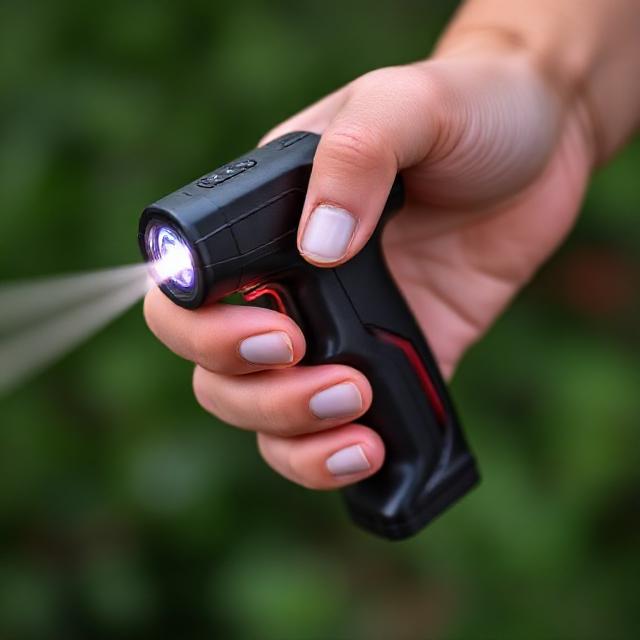
Stun guns require contact; tasers shoot probes. They disrupt muscle control, often dropping an attacker instantly. They work best when the defender has space and calm to aim correctly. In cramped hallways, probe spread can be limited.
3) Kinetic less‑lethal launchers
CO₂‑powered launchers that fire rubber balls, pepper‑filled rounds, or impact projectiles. They extend range beyond spray, allowing a defender to hold a line while moving family members to safety.
4) High‑lumen lights and alarms
A tactical flashlight can blind, identify, and control space. Alarms create a social weapon: noise calls neighbours and raises the intruder’s stress, which often breaks their plan.
5) Physical barriers and safe‑room planning
Doors, security gates, and pre‑planned retreat rooms are “non‑lethal” by design. They win by denying access rather than applying force.
Layered Defense: The Sandcastle Model
Security works like building on a beach. One wall won’t stop a wave. You need layers that slow, redirect, and finally halt the surge.
- Outer layer: lights, fences, neighbourhood coordination.
- Middle layer: cameras, alarms, dogs, reinforced entries.
- Inner layer: less‑lethal tools, safe‑room lock, phones ready.
Non‑lethal weapons fit best in the inner layer where mistakes are most costly and family safety is closest to the heart.
What Non‑Lethal Tools Can’t Do
- They can fail against highly motivated or armed attackers.
- They require realistic distance and timing.
- They won’t replace good locks, good lighting, and good habits.
- They are less effective if you have no escape or backup plan.
Seeing them as miracles is the quickest way to become a victim.
Training and Mindset
Home defense is mostly decision‑making. Tools matter, but the brain is the master switch. Practice should include:
- Knowing each tool’s range and limitations.
- Verbal commands and de‑escalation when safe.
- Moving family to a safe room quickly.
- Calling emergency services early, not after chaos starts.
Calm beats gadgets. A defender who panics wastes even the best equipment.
Traditional Conservative View
Conservative thinking supports the right to self‑defense because order depends on citizens not being helpless. But it also insists that force must be proportional and restrained. In that view, less‑lethal tools are not weakness—they are moral discipline. They let you protect your family while reducing the chance of unnecessary death.
The conservative principle is clear: defend life, but do not become reckless. Stability begins with self‑control.
FAQs
Are non‑lethal tools enough in South Africa?
They can be a strong layer in a broader security plan. Against armed intruders, you still need escape routes, alarms, and community response.
Do tasers work on everyone?
No tool works on everyone. Clothing, distance, health, and adrenaline affect outcomes. Train for failure and have backup plans.
Is pepper spray safe indoors?
It can work indoors but affects everyone in the room. Use it with ventilation in mind and retreat quickly.
Conclusion
Non‑lethal weapons are a sign of technological and moral maturity. They expand the spectrum between “do nothing” and “take a life.” In a society hungry for safety but tired of bloodshed, that spectrum matters.
Protect your home like you protect your soul: firmly, intelligently, and with restraint.
South African Legal Notes (Plain, Practical)
South African law allows self‑defense when you face an unlawful, immediate threat and your response is necessary and reasonable. Less‑lethal tools can help you meet that standard because they show proportional intent. But “reasonable” is judged case‑by‑case.
- Use force only to stop a threat, not to punish.
- If an intruder is fleeing and no longer a danger, continuing to attack can become unlawful.
- Always call police and medical help immediately after an incident. Reporting early supports your credibility.
This isn’t legal advice, but a street‑level reminder: the law cares about necessity, not anger.
Real‑World Scenarios
Scenario A: Noise at the kitchen door at night
You hear a door rattle. First response is not a weapon—it’s light and voice. A high‑lumen flashlight through a window, paired with a loud command, often ends low‑level break‑ins. If the threat continues, pepper spray or a launcher gives you distance while retreating to a safe room.
Scenario B: Intruder already inside
Distance is tight, so electrical stun devices or spray are more realistic than launchers. Your priority is to move family behind a locked barrier and create a choke point where the intruder must come through one narrow space.
Scenario C: Multiple intruders
Less‑lethal tools buy time, not victory. Use alarms, noise, and bright lights to disorient, then retreat. Your goal is survival, not heroism.
How to Choose the Right Non‑Lethal Tool
Different homes need different solutions. Ask practical questions:
- Space: small flats favour spray and stun devices; bigger properties can use launchers and layered barriers.
- Users: if elderly family members need access, simplicity matters more than high tech.
- Training time: buy what you will practice with, not what looks cool online.
- Environment: windy coastal yards can reduce spray reliability, so consider kinetic options.
The best tool is the one you can deploy calmly in the dark at 2 a.m.
Maintenance and Readiness
Less‑lethal tools still need care. Replace pepper spray before expiry. Test lights monthly. Keep tasers charged and know probe range. Store devices in fixed, known places—scrambling in panic is how people injure themselves.
Do a simple “Sunday check”: lights, batteries, alarm status, and a quick family reminder of the safe‑room plan. Consistency is security.
Community as a Defense Tool
The most powerful non‑lethal weapon is a connected neighbourhood. Criminals prefer silence and isolation. A street WhatsApp group, a shared camera network, and agreed alarm signals turn your individual home into part of a living fence.
Conservative community logic fits perfectly here: order is built from the ground up by citizens who cooperate, not by waiting for distant rescue.
The Escalation Ladder (Staying Human Under Threat)
Home defense works best when you think in steps. Step one is awareness: lights, alarms, and noise that warn and deter. Step two is verbal control: a clear loud command that tells an intruder they’ve been seen. Step three is less‑lethal force: spray, stun, or impact rounds to stop forward movement. Step four—only if all else fails—is lethal defense under law.
This ladder protects you morally and legally. It prevents panic from turning into overreaction. It also helps your family live with the outcome afterward. Many defenders who survive crime still struggle with guilt. Less‑lethal choices can reduce that burden without reducing safety.
Final Reminder
Gadgets don’t replace character. The safest household is one that plans, practices, and communicates. Non‑lethal tools are valuable precisely because they help decent people stay decent even in ugly moments.
If you prepare early, you won’t have to improvise later.