
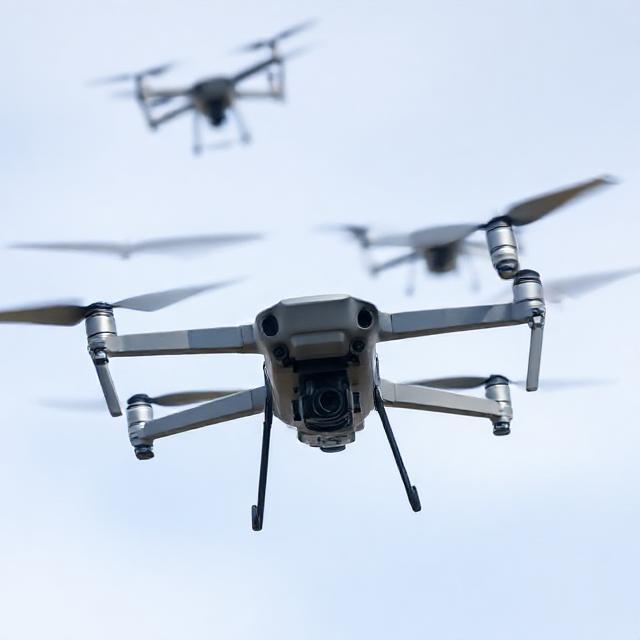
Drones in Warfare: The New Battlefront
How cheap aircraft and fast software rewired modern conflict — and what Africa must learn from it.
How We Got Here: From Hobby to Battlefield
Drones didn’t arrive in war like a meteor; they slid in quietly through consumer tech. In the 2000s UAVs were rare, mostly state-owned surveillance craft. Then phone cameras exploded in quality, lithium batteries got lighter, GPS chips became cheap, and tiny processors started doing what bulky military computers once handled. Suddenly a teenager’s racing drone could fly faster and steadier than some older military systems.
The 2010s saw drones used for reconnaissance and targeted strikes in the Middle East. But the real acceleration came after 2020, when conflicts such as Nagorno-Karabakh and then the Russia–Ukraine war turned drones into mass-produced weapons. The lesson was loud: a $500 FPV drone could destroy a tank, and because it was cheap, you could afford to lose many of them. Warfare began to look less like a duel between a few giants and more like a swarm of angry bees.
That shift matters for every region, including Africa. The barrier to entry for aerial power collapsed. Small states, private companies, militias, and criminals can all access the sky.
The Drone Family Tree (What’s Actually in the Sky?)
1) Micro and FPV strike drones
These are small quadcopters or racers flown through goggles. They’ve become the “AK-47 of the air” because they are easy to build from parts, easy to train on, and devastating at close range. A pilot guides the drone into a trench, vehicle hatch, or window before detonation. Their buzz is now a universal battlefield anxiety trigger.
2) Tactical ISR drones
ISR stands for Intelligence, Surveillance, Reconnaissance. These drones circle overhead for hours, spotting movement, mapping routes, and correcting artillery. Sometimes they don’t fire a single shot, yet they decide the fight by feeding data to others. Think of them as the battlefield’s nervous system.
3) Loitering munitions
Half drone, half missile. They fly to a zone, wait, then dive. They’re used to hunt radar systems, command posts, ammo dumps, and convoys. Their strategic value is forcing enemies to hide, disperse, and waste time.
4) Maritime and long-range drones
Larger UAVs patrol borders and coastlines, track smugglers, and deliver strikes deeper inside hostile terrain. Some are satellite-linked, extending reach beyond radio range.
Why Drones Are So Hard to Stop
Drones win by abusing three modern weaknesses: cost, clutter, and speed.
- Cost mismatch: Traditional air defenses were built to kill aircraft worth millions. Shooting a cheap drone with an expensive missile is like swatting flies with a diamond hammer. Economically, defenders bleed first.
- Cluttered airspace: Low altitude flight lets drones slip between trees, buildings, hills, and radar blind spots. They become hard to detect until they are close.
- Speed of adaptation: A drone design that fails on Monday is redesigned by Friday. Operators watch videos, share tactics, and update firmware faster than governments can update procurement plans.
Even when a drone is shot down, it still drains resources and attention. That’s part of its power.
The Human Effect: War Under a Glass Ceiling
Imagine fighting while being watched all the time. Drones create psychological pressure that never sleeps. Soldiers can’t relax, can’t move carelessly, can’t light a fire without risking detection. Every track in sand becomes evidence. Every vehicle parked in the open becomes a target.
This constant surveillance changes behaviour. Armies spread out, camouflage more aggressively, and move at night. But the sky learns too—thermal cameras pierce darkness, and AI-assisted targeting reduces guesswork.
“The drone age doesn’t just kill bodies. It kills the old idea that hiding is easy.”
Africa’s Drone Reality
Africa’s terrain makes drones both attractive and dangerous. Wide borders, remote communities, and underfunded air forces mean UAVs can do jobs that helicopters and jets can’t afford to do routinely.
- Counter‑insurgency: Drones are already used against militant groups in the Sahel and Horn of Africa.
- Border and maritime patrol: Long coastlines and porous borders benefit from low-cost aerial monitoring.
- Crime and smuggling: Traffickers can also use drones to scout police routes or move contraband.
The lesson is simple: if states don’t build drone capacity, hostile actors will. Power doesn’t skip a vacuum.
Counter‑Drone Defense in Plain Language
No single tool ends the drone problem. Defense must be layered, like reef rocks that break a wave in stages.
Electronic jamming
Shotguns / autocannons
Decoys
Hardened shelters
Net systems
But every layer triggers new offense. Jam radio drones, and tethered fiber‑optic drones appear. Add nets, and micro‑drones learn to fly around them. The race never ends, so preparation must be continuous.
FAQs
Are drones replacing tanks and artillery?
No, but they are redefining their use. Tanks now need drone cover and anti‑drone kits; artillery relies on drones for spotting and rapid correction.
Why do cheap drones beat expensive armies?
Because quantity plus intelligence overwhelms high‑value systems. When drones are disposable, the attacker can accept losses and keep pushing.
What should African states prioritize?
Local production, operator training at scale, and counter‑drone electronic warfare. Buying a few elite drones is not enough.
Conclusion
Drones have opened a new frontline above our heads. They compress time, expose movement, and reward adaptation. The future battlefield belongs to whoever controls the sky’s smallest machines.
Africa must not wait for the storm to arrive; it is already raining drones.
The Economics of Swarm Warfare
War used to be dominated by a few expensive platforms: fighter jets, bombers, tanks, warships. Drones invert that logic. They make mass the decisive resource. A country that can manufacture tens of thousands of drones per month gains an advantage no single “wonder weapon” can match.
This turns defense planning into something close to industrial policy. Supply chains for motors, batteries, cameras, and chips become national-security arteries. The states that protect and scale these supply chains will endure. Those that rely entirely on imports will learn, painfully, that shipments can be delayed, sanctioned, or sabotaged.
For poorer countries, this is a rare strategic opening. It is cheaper to build a drone factory than a jet program. It is cheaper to train drone operators than fighter pilots. The sky is no longer a luxury club.
Ethics and Accountability in the Drone Age
Drones shorten the distance between decision and death. That is not automatically immoral, but it raises hard questions. When combat becomes remote, the temptation to apply force more often increases. Leaders see “low-risk strikes” and can slide into escalation without feeling the weight of body bags at home.
There is also the issue of civilian harm. Micro‑drones can be aimed carefully, but they are also used in cities where a single misidentification becomes tragedy. Good doctrine matters: clear targeting rules, disciplined supervision, and transparent investigations when strikes go wrong.
Conservative ethics emphasizes responsibility and restraint in power. If a nation gains drone dominance, it also gains a duty to use that power under law, not impulse.
A Practical Roadmap for South Africa
South Africa doesn’t need to imitate superpowers. It needs to build a locally relevant drone posture.
- Domestic production at scale: incentivize local manufacturers, universities, and defense firms to mass-produce robust tactical drones and FPV systems.
- Operator pipelines: create training paths in the SANDF and police, and partnerships with civilian drone racing communities who already understand FPV flight.
- Electronic warfare units: treat counter‑drone jamming, detection, and spoofing as a standing capability, not a special project.
- Civil defense integration: align military drone skills with disaster management, fire mapping, and search‑and‑rescue to keep the ecosystem healthy during peacetime.
That approach builds readiness without wasting money on prestige projects.
Where Drone Warfare Is Headed Next
The next phase of drone conflict will be shaped by software more than hardware. Three trends are already visible.
AI-assisted targeting: drones will increasingly recognize vehicles, uniforms, and heat signatures automatically, cueing human pilots to approve strikes faster. This will reduce operator fatigue and allow small teams to control large drone fleets.
Swarms and coordination: rather than single drones hunting targets, groups will cooperate. One drone maps defenses, another distracts, a third strikes. Swarms will force defenders to choose which threat to stop while others slip through.
Multi-domain drones: warfare is not only in the air. Uncrewed surface boats and underwater drones are showing up near coastlines, while ground robots carry supplies through dangerous corridors. The “unmanned revolution” is becoming a full ecosystem.
For Africa, this means the skills learned today—navigation, electronic warfare, rapid prototyping—will remain relevant even as models change. The sky is turning into a marketplace of constant innovation.
A Final Word on Responsibility
Drones are neither angels nor demons. They are tools that magnify the intent of the people who build and fly them. Used well, they can reduce casualties by improving precision and situational awareness. Used recklessly, they can spread terror cheaply and endlessly.
The moral difference will not be made by technology. It will be made by discipline, law, and leadership.